
Warehouse & Delivery: receive, pick, ship and deliver
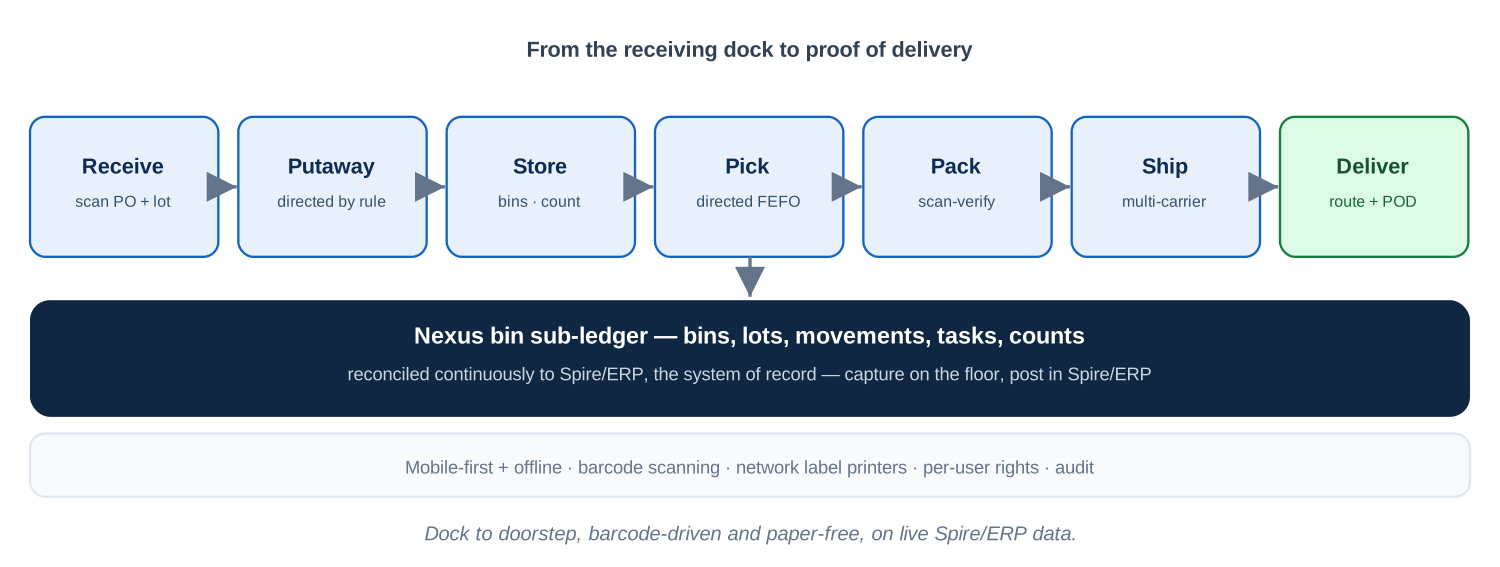
A full warehouse and last-mile delivery layer on one core: receiving, putaway, directed picking, packing, shipping, and cycle counting, plus route planning, a driver app on the phone, and proof-of-delivery. Land with the warehouse and add delivery when you are ready.
Key capabilities
- Receiving, putaway, picking, packing, shipping, and cycle counts
- Scanning at receiving and packing, with bin and lot tracking
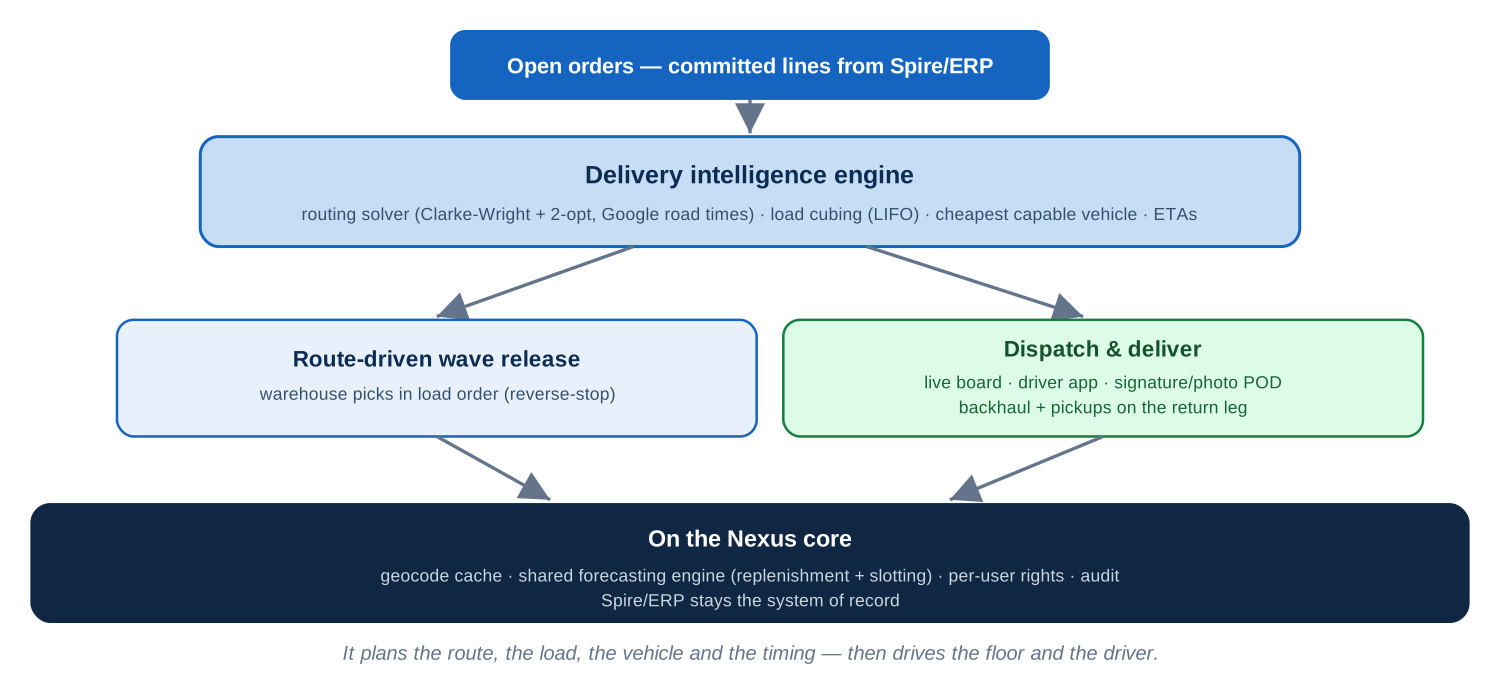
- Route planning + load building for last-mile delivery
- Driver app on the phone with proof-of-delivery (photo & signature)
- Reads your Spire stock live, with a bins-against-Spire reconciliation
- Dock scheduling, backhauls, and delivery analytics
The flow, end to end
-
Receive and put away
Scan items in at the dock and put them away where Nexus suggests, with the reason for each suggestion shown. Dock doors can be booked ahead for inbound purchase orders and outbound routes.
-
Pick in the order the truck loads
Pick waves are released from each route in reverse drop order, so staging matches the load. Allocation takes the stock that expires first and never draws from damaged or quarantine bins.
-
Pack, check and ship
If what was packed does not match what was picked, the shipment is blocked until someone overrides it and records why. Each package gets its own tracking number, weight and label.
-
Deliver and prove it
Each route goes to the cheapest truck with the capacity and equipment it needs. Drivers capture a photo and a signature at every stop, and dispatch sees anything running late on a live board and map.
A Nexus module
Warehouse & Delivery (WMS + TMS) draws on the same live data as everything else you run on Nexus, so it works in step with your other modules: no syncs, no exports. Add it on top of the platform: a monthly fee per company, scaled to your plan and the size of the team using it, with no per-seat charge.
What people ask about Warehouse & Delivery
Does it change stock in Spire?
Only where you switch it on. Nexus keeps its own bin-level ledger and reads Spire's stock live, with a screen that reconciles the two. Each kind of write into Spire has its own switch, and every switch starts off. Among them: receiving a purchase order at the dock, sending a count's differences to Spire as an inventory adjustment, adding a new barcode to a part, and committing stock that has arrived to the orders waiting for it. With a switch off, your team does that step in Spire itself.
Do drivers need an app from the App Store?
No. The driver app runs in the browser on their phone, so there is nothing to download from an app store. It captures a photo and a signature at every stop.
Can we start with the warehouse and add delivery later?
Yes. The warehouse and delivery each have their own switch, so you can run one without the other.
How are delivery routes planned?
A route solver orders the stops, with Google road times if you want them, and matches each route to the cheapest truck with the capacity and equipment it needs, such as a tailgate or a crane. Vendor pickups and customer returns can ride on whichever route passes closest.
Add Warehouse & Delivery (WMS + TMS) to your Nexus
Book a demo and see it running on your own data, connected to the systems you already use.